The San Francisco-based newspaper, AsianWeek, on its website today issued an apology and a rejection of the "biased views" of its columnist, Kenneth Eng, following the wide condemnation of his article, "Why I Hate Blacks".
The paper further announced the author's firing and promised a review of the editorial processes that let the article be published. The paper is reported to be planning a town hall-style meeting in San Francisco in the near future.
More on the apology and Kenneth Eng controversy.
Wednesday, February 28, 2007
Job: Clinical Counselor Working with APA Students (IL)
Head's up on featured opportunity at IMDiversity AAV:
Clinical Counselor Working with APA Students (IL)
University of Illinois Urbana-Champaign
Deadline: March 9, 2007
REQUIRED
Doctorate in Clinical, Clinical/Community, or Counseling Psychology, or Masters in Social Work is required.
2. Demonstrated interest, expertise, and experience in clinical and outreach work with Asian American students are required.
3. Demonstrated competence in multicultural programming and multicultural clinical work is required.
4. Demonstrated ability to function at a high level as a generalist counselor in a setting with both diverse clients and staff colleagues is required.
5. License in Illinois or license-eligible background as a psychologist or clinical social worker is required.
6. Previous experience in a college counseling center is preferred, but not required.
Conditions:1. Starting Date: August 1, 2007 or mutually acceptable date.
More details
Clinical Counselor Working with APA Students (IL)
University of Illinois Urbana-Champaign
Deadline: March 9, 2007
REQUIRED
Doctorate in Clinical, Clinical/Community, or Counseling Psychology, or Masters in Social Work is required.
2. Demonstrated interest, expertise, and experience in clinical and outreach work with Asian American students are required.
3. Demonstrated competence in multicultural programming and multicultural clinical work is required.
4. Demonstrated ability to function at a high level as a generalist counselor in a setting with both diverse clients and staff colleagues is required.
5. License in Illinois or license-eligible background as a psychologist or clinical social worker is required.
6. Previous experience in a college counseling center is preferred, but not required.
Conditions:1. Starting Date: August 1, 2007 or mutually acceptable date.
More details


Asians in Medical Professions vs. the Executive Suite
While rennovating and expanding the IMDiversity Healthcare Industry Careers Channel, the editors stumbled across a few sobering stats about barriers to advancement for Asian Americans and Pacific Islanders in a field where, stereotypically, one might least expect it.
According to a 2003 aggregate report by the U.S. Equal Employment Opportunity Commission, Asian Americans were in some sense "over-represented" in the healthcare field. Asian Americans constituted 5.2 percent of the total Healthcare and Social Assistance workforce, and 7.7 percent of "Professional" positions (including doctors, dentists, nurses, etc.), according to the report. At 4-point-something percent of the U.S. population in 2003, these figures are not too shabby, and seem to give evidence to the idea that we are "doing well," playing a leading role in this all-important, fastest-growing industry.
Chalk it up to what you will -- whether a high number of Indian, Chinese and Filipino doctors, nurses and researchers admitted to help ease the U.S. healthcare worker shortage on special visas, or simply intense parental pressure to be a doctors ... ;-)
However, a closer look at the next column shows that Asian Americans held only 3.0 percent of the "Officials & Managers" positions. Think, the hospital administrators and clinic managers, the behind the scenes and office positions, perhaps the heads of private labs ... or medical school research centers.
For all other minority groups, the percentages holding Professional positions and Official/Management positions were virtually identical.
This seems to make the healthcare profession consistent with other technical fields where a glass ceiling exists. Asians are presumed compentent and hard-working, skilled and highly educated, but perhaps not possessing the stuff of enjoying the fruits of their contributions in management at the top-levels.
One result is that many organizations, scholarships, and official initiatives established to create a measure of equity for minorities in the profession do not include Asians. We may in the aggregate excel at serving as doctors and nurses and technicians. Yet, as important and worthy as these occupations may be, additional research is needed. First, clear disparities in the quality of healthcare exist along ethnic lines, and this goes for Asian Americans as well. This seems counterintuitive; one would think with all those Asian doctors and nurses toiling away out there, Asian Americans would be receiving fantastic, culturally-targeted, in-language medical care more than most groups. But research into the dearth of Asian Americans who are decision-makers and purse-string holders in the management offices of the industry may point the way new kinds of access, research and attention to the benefit of Asian Americans' healthcare.
On a final note: The research into the representation of Pacific Islanders and Native Hawaiians in the industry is releatively new, and the subject for another day. However, already, it's clear that the disparities are even more pronounced in this group -- in terms of both access to the best healthcare and representation in the professions.
According to a 2003 aggregate report by the U.S. Equal Employment Opportunity Commission, Asian Americans were in some sense "over-represented" in the healthcare field. Asian Americans constituted 5.2 percent of the total Healthcare and Social Assistance workforce, and 7.7 percent of "Professional" positions (including doctors, dentists, nurses, etc.), according to the report. At 4-point-something percent of the U.S. population in 2003, these figures are not too shabby, and seem to give evidence to the idea that we are "doing well," playing a leading role in this all-important, fastest-growing industry.
Chalk it up to what you will -- whether a high number of Indian, Chinese and Filipino doctors, nurses and researchers admitted to help ease the U.S. healthcare worker shortage on special visas, or simply intense parental pressure to be a doctors ... ;-)
However, a closer look at the next column shows that Asian Americans held only 3.0 percent of the "Officials & Managers" positions. Think, the hospital administrators and clinic managers, the behind the scenes and office positions, perhaps the heads of private labs ... or medical school research centers.
For all other minority groups, the percentages holding Professional positions and Official/Management positions were virtually identical.
This seems to make the healthcare profession consistent with other technical fields where a glass ceiling exists. Asians are presumed compentent and hard-working, skilled and highly educated, but perhaps not possessing the stuff of enjoying the fruits of their contributions in management at the top-levels.
One result is that many organizations, scholarships, and official initiatives established to create a measure of equity for minorities in the profession do not include Asians. We may in the aggregate excel at serving as doctors and nurses and technicians. Yet, as important and worthy as these occupations may be, additional research is needed. First, clear disparities in the quality of healthcare exist along ethnic lines, and this goes for Asian Americans as well. This seems counterintuitive; one would think with all those Asian doctors and nurses toiling away out there, Asian Americans would be receiving fantastic, culturally-targeted, in-language medical care more than most groups. But research into the dearth of Asian Americans who are decision-makers and purse-string holders in the management offices of the industry may point the way new kinds of access, research and attention to the benefit of Asian Americans' healthcare.
On a final note: The research into the representation of Pacific Islanders and Native Hawaiians in the industry is releatively new, and the subject for another day. However, already, it's clear that the disparities are even more pronounced in this group -- in terms of both access to the best healthcare and representation in the professions.
Sunday, February 25, 2007
Pipa Sensation Yang Wei
I have fallen completely in love with the pipa, the Chinese lute. The pipa is a stringed instrument that originated in the Middle East as the oud and has existed in China since the Qin Dynasty, 221-207 BC. It is now becoming a “world instrument” like violin or piano.
I recently heard pipa performed as the centerpiece of theatrical dream team Bright Sheng, David Henry Hwang, and Ong Keng Sen's musical theatre opera, The Silver River, at the University of Michigan.
Then pipa virtuoso, Yang Wei, came to the University of Michigan as an artist-in-residence for two weeks and I went to hear him perform and speak four times! Mr. Yang is an incredible musician and a charming person, peppering his performances of classical Chinese, contemporary Chinese, and Western music (Home on the Range, Oh Susanna “...with a pipa on my knee”) with stories about coming to America from Shanghai, drawing parallels between learning pipa and learning English (and how to drive).
Yang Wei is also part of Yo-Yo Ma’s Silk Road Project which has “a vision of connecting the world’s neighborhoods by bringing together artists and audiences around the globe. Inspired by the cultural traditions of the historic Silk Road, the Silk Road Project is a catalyst promoting innovation and learning through the arts.” This is not just explorations of the traditional instruments and traditional music, but also exciting new collaborations between many of these instruments and musical traditions.
Chicago is the first city in the world to collaborate in a year-long partnership with The Silk Road Project, including performances, master classes, workshops and educational programs featuring Yo-Yo Ma and other Silk Road Ensemble members.
Check out the videos of the Silk Road Ensemble in action on Yang Wei’s website, and try to catch them in one of their upcoming concerts. They are so cool.
I recently heard pipa performed as the centerpiece of theatrical dream team Bright Sheng, David Henry Hwang, and Ong Keng Sen's musical theatre opera, The Silver River, at the University of Michigan.
Then pipa virtuoso, Yang Wei, came to the University of Michigan as an artist-in-residence for two weeks and I went to hear him perform and speak four times! Mr. Yang is an incredible musician and a charming person, peppering his performances of classical Chinese, contemporary Chinese, and Western music (Home on the Range, Oh Susanna “...with a pipa on my knee”) with stories about coming to America from Shanghai, drawing parallels between learning pipa and learning English (and how to drive).
Yang Wei is also part of Yo-Yo Ma’s Silk Road Project which has “a vision of connecting the world’s neighborhoods by bringing together artists and audiences around the globe. Inspired by the cultural traditions of the historic Silk Road, the Silk Road Project is a catalyst promoting innovation and learning through the arts.” This is not just explorations of the traditional instruments and traditional music, but also exciting new collaborations between many of these instruments and musical traditions.
Chicago is the first city in the world to collaborate in a year-long partnership with The Silk Road Project, including performances, master classes, workshops and educational programs featuring Yo-Yo Ma and other Silk Road Ensemble members.
Check out the videos of the Silk Road Ensemble in action on Yang Wei’s website, and try to catch them in one of their upcoming concerts. They are so cool.
Monday, February 05, 2007
More Buzz: APAs and a Dem Weekend
Asian American activists of all stripes gathered in MD suburbs this past weekend for a series of events coinciding with the Dem-fest in DC.
Attending were folks representing national grassroots organizations such as APAs for Progress and Real Americans for Democracy (a next-gen project rising from the success of "macaca-slayers" Real Virginians for Webb), PACs like the Asian American Action Fund, as well as APA staffers from campaigns and Congressional offices, those who had worked APIA outreach for the DNC, and folks from ethnic media and local community service organizations.
In addition to buzzing about the field of new Presidential candidates and debriefing from the midterms, the series of meetings provided an opportunity for a highly energized and diverse body of Asian Americans to network, weigh future cooperative projects, and discuss problems and priorities in the community.
Although as diverse a bunch as you could find -- style, region, ethnicity, age, profession -- I overheard some common themes in the group buzz.
Attending were folks representing national grassroots organizations such as APAs for Progress and Real Americans for Democracy (a next-gen project rising from the success of "macaca-slayers" Real Virginians for Webb), PACs like the Asian American Action Fund, as well as APA staffers from campaigns and Congressional offices, those who had worked APIA outreach for the DNC, and folks from ethnic media and local community service organizations.
In addition to buzzing about the field of new Presidential candidates and debriefing from the midterms, the series of meetings provided an opportunity for a highly energized and diverse body of Asian Americans to network, weigh future cooperative projects, and discuss problems and priorities in the community.
Although as diverse a bunch as you could find -- style, region, ethnicity, age, profession -- I overheard some common themes in the group buzz.
- One was a general sense that the Democratic Party has taken a demonstrable turn in the last couple of elections, paying more attention to APAs and expanding opportunities for them to be involved at multiple levels of the Party.
- Another was that this investment has demonstrably paid off, and it is likely that efforts to outreach to APA constiuencies will probably see continued, increased support in the Party moving forward. We'll probably see more Asian faces at the conventions, on staffs, and out there stumping and canvassing.
- A third was that the midterms saw an increasing number of dedicated APAs, especially younger people, gaining valuable field experience and becoming engaged in campaigns and GOTV at a deeper level than in the past, and as a result...
- Asian Americans may still be far away from having a big umbrella organization like a La Raza or NAACP, but building coalition and cooperation seems to be a common interest among disparate activist groups intrested in affecting elections. (On a related note, see the coincidental release by the new 80-20 Initiative board this weekend, too.)
And what did the group have to say about the candidates? I can't say a consensus favorite emerged this weekend, but on one thing everyone seemed to agree: Asian Americans are looking for Bill Richardson to address The Wen Ho Lee issue, and it probably won't be comfortable for him.
More later...
Buzz: Changing of the Guard at 80-20
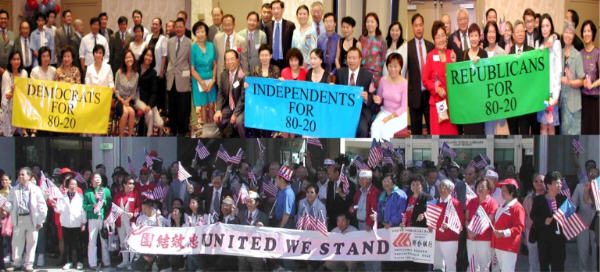
After years with founding President S.B. Woo at the helm, the 80-20 Initiative and PAC -- a national organization dedicated to creating an Asian American swing vote through promoting a bloc-voting strategy -- is seeing a wave new faces on its executive committee and board of officers. The organization's new President, Kathleen To, announced the leadership changes in a release circulated on February 3.
The message also acknowledges that Woo (who was term-limited out as 80-20 president this year) leaves some very big shoes to fill. (Woo has said he will continue to play a role in the organization, possibly focusing on a recently developed education foundation project.) Indeed, To will face some challenges as she takes the helm of an organization that has been so closely aligned with the name of the founder. This identification with Woo has created some obstacles for 80-20 in its past efforts to build multipartisan coalition. Although 80-20's decision-making committees are constituted of equal numbers of Democrats, Republicans and independents, Republicans who failed to win the organization's consensus endorsements have routinely accused it of partisanship because Woo had been a Democrat when he served as Lt. Governor of Delaware.
The new leadership change, then, can provide a good opportunity for 80-20 to put some distance between itself and these charges, and to strike out in some new directions, too. The message from To suggests that a key goal is "to reach out and co-operate with all other Asian American organizations, [and] reach out to our Congressional Delegations."
For a time 80-20 was regarded as the only national, pan-Asian political action organization of note that could provide formal endorsements, it got a reputation for going things its own way and not really working in coalition with other organizations who were also dedicated to community concerns, voter participation, and so forth. Further, in its early years, 80-20 had reserved its endorsements and member energies exclusively for presidential races, generally shying from Congressional or gubernatorial races and leaving midterm elections alone.
Beginning last year, however, 80-20's consensus focus on combating glass ceiling discrimination through Congressional hearings gave it an opportunity to weigh in on midterm races, and it received high-level attention on the issue from the new DNC chair Howard Dean.
The new board will be holding its annual meeting in Washington DC in April. We will likely see some more announcements of new directions and deals then.
The message also acknowledges that Woo (who was term-limited out as 80-20 president this year) leaves some very big shoes to fill. (Woo has said he will continue to play a role in the organization, possibly focusing on a recently developed education foundation project.) Indeed, To will face some challenges as she takes the helm of an organization that has been so closely aligned with the name of the founder. This identification with Woo has created some obstacles for 80-20 in its past efforts to build multipartisan coalition. Although 80-20's decision-making committees are constituted of equal numbers of Democrats, Republicans and independents, Republicans who failed to win the organization's consensus endorsements have routinely accused it of partisanship because Woo had been a Democrat when he served as Lt. Governor of Delaware.
The new leadership change, then, can provide a good opportunity for 80-20 to put some distance between itself and these charges, and to strike out in some new directions, too. The message from To suggests that a key goal is "to reach out and co-operate with all other Asian American organizations, [and] reach out to our Congressional Delegations."
For a time 80-20 was regarded as the only national, pan-Asian political action organization of note that could provide formal endorsements, it got a reputation for going things its own way and not really working in coalition with other organizations who were also dedicated to community concerns, voter participation, and so forth. Further, in its early years, 80-20 had reserved its endorsements and member energies exclusively for presidential races, generally shying from Congressional or gubernatorial races and leaving midterm elections alone.
Beginning last year, however, 80-20's consensus focus on combating glass ceiling discrimination through Congressional hearings gave it an opportunity to weigh in on midterm races, and it received high-level attention on the issue from the new DNC chair Howard Dean.
The new board will be holding its annual meeting in Washington DC in April. We will likely see some more announcements of new directions and deals then.
Sunday, January 28, 2007
FKwang article in New Adoption Parenting Book by EMK Press

Check out Frances' article on page 319 and 332!
Release below:
EMK Press is proud to announce our NEW, groundbreaking parenting book:
Adoption Parenting: Creating a Toolbox, Building Connections
Edited by Jean MacLeod and Sheena Macrae, PhD
Finally, a comprehensive parenting book for adoptive families!
Over 100 contributors have helped EMK Press to weave a stunning tapestry of advice specifically for adoptive parents. Parenting adopted children requires parenting with an extra layer and this book helps you to understand where that extra layer falls. This over 500 page book is a wealth of information for the newly arrived home family and the experienced family as well. This is a book you won’t read all at once, but come back to again and again as your child’s awareness of who they are develops and your awareness of how to help them increases.Our adopted children come to us from loss–loss of a birthfamily, culture, and language. There are helpful things that we can do to address these issues, and Adoption Parenting helps you to create an awareness to do just that. We also look at stumbling blocks to good parenting, and standard parenting practices that aren’t right for adopted children. We look at the core issues all members of the adoption triad face, and look at how that affects standard parenting challenges like sleeping through the night, discipline, and attachment. We cover specific challenges families have faced: FASD, Trauma and PTSD, Sensory Integration, Speech and Language delays, and at ways to effectively parent a post-institutionalized child or a child who has experienced trauma in their journey to you.
To see the actual table of contents, click below
Front Matter and Table of Contents: frontmatter.pdf
First Chapter Getting Started Click to view
To see the actual table of contents, click below
Front Matter and Table of Contents: frontmatter.pdf
First Chapter Getting Started Click to view
Saturday, January 27, 2007
NYC Exhibition: Erasing Borders: Indian Artists in the American Diaspora
Indo-American Arts Council Inc
and the
Queens Museum of Art
present
Erasing Borders: Indian Artists in the American Diaspora
curated by vijay kumar
February 4 - March 4, 2007
Queens Museum of Art
Flushing Meadows, Corona Park, New York
featuring Reeta Karmarkar, Vijay Kumar, Bivas Chaudhuri, Satish Joshi, Siona Benjamin, Tara Sabharwal, Nitin Mukul, Ela Shah, Vinod Dave, Nandini Chirimar, Antonio Puri, Anna Bhushan, Delna Dastur, Niyeti Chadha, Alka Mukerji, Yamini Nayar
and the
Queens Museum of Art
present
Erasing Borders: Indian Artists in the American Diaspora
curated by vijay kumar
February 4 - March 4, 2007
Queens Museum of Art
Flushing Meadows, Corona Park, New York
featuring Reeta Karmarkar, Vijay Kumar, Bivas Chaudhuri, Satish Joshi, Siona Benjamin, Tara Sabharwal, Nitin Mukul, Ela Shah, Vinod Dave, Nandini Chirimar, Antonio Puri, Anna Bhushan, Delna Dastur, Niyeti Chadha, Alka Mukerji, Yamini Nayar
Friday, January 26, 2007
AAV News Weekend Supplement - Jan 26
As we sometimes do, AAV's adding extra weekend arts and sports items from the AP:
But is that what the controvery is really about?
As the article observes, Maui County is 31 percent Asian, 10 percent Native Hawaiian or Pacific Islander, and 22 percent mixed race. Caucasians account for 33 percent of the county, including the small islands of Lanai and Molokai.
The all-haole casting has some locals ... not quite up in arms ... but annoyed, in the same sort of way that makes them charge mainlanders higher prices for pretty much everything. (AAV's editors Stewart Ikeda and Frances Wang have both been spending a lot of time in Hawai'i lately.)
The bigger sore spot is that the contestants on the show all seem to be on Maui for the main purpose of getting lucky -- frequently and on-camera.
"The first episode highlights a group of men who target tourists for fast, easy, and noncommittal hookups," the article says, which left some residents disgruntled, such as Nathan Ugale, 16, of Lahaina.
The article quotes Ugale from the Maui News: “I don't want (tourists) to come to Maui and think that people are going to come up to their daughters, so 'I better keep them away.' It's good for TV but not when it's happening in the town that you live in, that you've been a part of your whole life.”
[BY THE WAY: Also from Maui News: Click to see Matthew Thayer's photo of what must surely be the world's largest spam musubi ever -- 60 feet! We can't link to it b/c it gives a server error, but see the homepage today or maybe Google "SIXTY FEET OF SPAM MUSUBI" laterand see what happens.]
Anyway, stop in and check out the weekend edition of the Village news, and let us know what you think of the show.
- Maui residents object to island's portrayal in new MTV reality show, Maui Fever
- India to finally see Deepa Mehta's Water…7 years late
- Playwright Hwang to launch Stanford Univ.-NY Public Theater partnership series
- Ang Lee calls Tony Leung Chiu-wai 'dream' actor in his new movie
- Contract issue hangs over Mariners, Ichiro
But is that what the controvery is really about?
As the article observes, Maui County is 31 percent Asian, 10 percent Native Hawaiian or Pacific Islander, and 22 percent mixed race. Caucasians account for 33 percent of the county, including the small islands of Lanai and Molokai.
The all-haole casting has some locals ... not quite up in arms ... but annoyed, in the same sort of way that makes them charge mainlanders higher prices for pretty much everything. (AAV's editors Stewart Ikeda and Frances Wang have both been spending a lot of time in Hawai'i lately.)
The bigger sore spot is that the contestants on the show all seem to be on Maui for the main purpose of getting lucky -- frequently and on-camera.
"The first episode highlights a group of men who target tourists for fast, easy, and noncommittal hookups," the article says, which left some residents disgruntled, such as Nathan Ugale, 16, of Lahaina.
The article quotes Ugale from the Maui News: “I don't want (tourists) to come to Maui and think that people are going to come up to their daughters, so 'I better keep them away.' It's good for TV but not when it's happening in the town that you live in, that you've been a part of your whole life.”
[BY THE WAY: Also from Maui News: Click to see Matthew Thayer's photo of what must surely be the world's largest spam musubi ever -- 60 feet! We can't link to it b/c it gives a server error, but see the homepage today or maybe Google "SIXTY FEET OF SPAM MUSUBI" laterand see what happens.]
Anyway, stop in and check out the weekend edition of the Village news, and let us know what you think of the show.
Thursday, January 25, 2007
Bobby Jindal running for Louisiana Gov.; up in polls

In this Week's Asian American Village News Headlines:
U.S. Representative Bobby Jindal, a Louisiana Republican, has announced that he is running to replace Kathleen Blanco as the state's governor. Although Jindal lost his first gubernatorial campaign against Blanco in 2003, the Governor has been weakened since Hurricane Katrina, and Jindal seems to have a good shot at becoming the state's first Indian American governor.
According the AP, a survey of likely voters this month by Southern Media & Opinion Research found that 59 percent favored Jindal and 35 percent favored Blanco (margin of error +/- 4 percentage points).
Interesting Factoid to Watch: Expect to see widespread claims that victory would make Jindal "the first Indian American governor," but this particular milestone has been recently scooped by -- just last month, in fact. Apparently, the honor of that claim goes to New Jersey transportation commissioner Kris Kolluri, who was also the the first Indian American to hold a cabinet post in New Jersey, according to the Times of India. To be precise, as originally reported in the Newark Star-Ledger, Kolluri acted as the Garden State's acting governor for a day while Gov. Jon Corzine and other officials going down the list were out of town on holiday.
So, a victorious Jindal would have to settle for "first elected Indian American governor".
U.S. Representative Bobby Jindal, a Louisiana Republican, has announced that he is running to replace Kathleen Blanco as the state's governor. Although Jindal lost his first gubernatorial campaign against Blanco in 2003, the Governor has been weakened since Hurricane Katrina, and Jindal seems to have a good shot at becoming the state's first Indian American governor.
According the AP, a survey of likely voters this month by Southern Media & Opinion Research found that 59 percent favored Jindal and 35 percent favored Blanco (margin of error +/- 4 percentage points).
Interesting Factoid to Watch: Expect to see widespread claims that victory would make Jindal "the first Indian American governor," but this particular milestone has been recently scooped by -- just last month, in fact. Apparently, the honor of that claim goes to New Jersey transportation commissioner Kris Kolluri, who was also the the first Indian American to hold a cabinet post in New Jersey, according to the Times of India. To be precise, as originally reported in the Newark Star-Ledger, Kolluri acted as the Garden State's acting governor for a day while Gov. Jon Corzine and other officials going down the list were out of town on holiday.
So, a victorious Jindal would have to settle for "first elected Indian American governor".
[Image" "Talking with dairy farmers: Congressman Jindal holds a forum with local dairy farmers" from http://jindal.house.gov/]
Sunday, January 21, 2007
Asian American Career Center: Featured Opportunities
Featured Editor's Pick at the Asian American Village Jobs for US Center, powered by IMDiversity.com:
Clinical Counselor Position #10935: University of Illinois - Urbana-Champaign
Posted Jan 9, 2007
Deadline: March 9, 2007
This Clinical Counselor position combines generalist counselor duties with a special emphasis in clinical and outreach work with Asian American students. Position starts August 1, 2007.
Editor's Note: UIUC is known as the home of one of the most dynamic, up-and-coming Asian American Studies and cultural scenes in the Midwest. Long-time Villagers may recall our early feature from 2003, Building Asian American and Ethnic Studies in the Midwest, by Sharon Lee at UIUC, detailing the challenges, growth prospects, and new opportunities for ethnic studies programs in the Heartland. Since then, UIUC has been steadily hiring new talent for administrators and faculty to build not only a strong academic program in AAS, but also related resource centers and support. If you're interested in working in an role providing support to Asia Americans, and being part of a vibrant Asian American community while enjoying a small, manageable city with a good standard of living, we think you should note the deadline and check this one out.
-- AAV Editors
Clinical Counselor Position #10935: University of Illinois - Urbana-Champaign
Posted Jan 9, 2007
Deadline: March 9, 2007
This Clinical Counselor position combines generalist counselor duties with a special emphasis in clinical and outreach work with Asian American students. Position starts August 1, 2007.
Editor's Note: UIUC is known as the home of one of the most dynamic, up-and-coming Asian American Studies and cultural scenes in the Midwest. Long-time Villagers may recall our early feature from 2003, Building Asian American and Ethnic Studies in the Midwest, by Sharon Lee at UIUC, detailing the challenges, growth prospects, and new opportunities for ethnic studies programs in the Heartland. Since then, UIUC has been steadily hiring new talent for administrators and faculty to build not only a strong academic program in AAS, but also related resource centers and support. If you're interested in working in an role providing support to Asia Americans, and being part of a vibrant Asian American community while enjoying a small, manageable city with a good standard of living, we think you should note the deadline and check this one out.
-- AAV Editors
Wednesday, January 17, 2007
Singaporean Director Ong Keng Sen--Beyond Cool
On January 12, I had the opportunity to hear the incredibly brilliant and beautiful Singaporean director of The Silver River, Ong Keng Sen, speak at the University of Michigan Center for Southeast Asian Studies about Collaboration across Borders in Art and Culture. He has received international acclaim for epic theatrical presentations that bridge cultures, making theatre a transcultural, transdisciplinary, collaborative art. He is very interested in the politics and negotiation of cultural expressions and collaborations that cross cultural boundaries, and using traditional and contemporary art to forge a new multicultural pan-Asian identity across international lines, asserting a new Asian asthetic in contemporary theatre.
I am always writing about APAs creating culture, multicultural living, pan-Asian alliances, and teaching our children about both their Asian heritage and their place in American history. However, it had never occurred to me that Asians in Asian countries might have some of the same concerns. I think that we APAs sometimes try to distance ourselves from contemporary Asians in Asia because we are tired of always being mistaken for foreigners or because we think of Asian culture as old and out of date. It doesn’t have to be that way. Instead, we could be part of something bigger than “Yul Kwon wins Survivor” and “Rosie O’Donnell said ‘ching chong ching chong.’”
Check this out from Theatreworks.org.sg: “Theatreworks asks, What is Asian in this age of globalisation, internationalization, modernisation and urbanisation? Its work exists on the tension between modernity and tradition; local and global. It hopes to rethink what is Western, what is Eastern, what is first world and what is third world: Do these dichotomies continue to make sense in the new millennium? Representing the continuum between tradition and contemporary, the work is unafraid to be exotic and yet conceptual. Theatreworks' aesthetics projects the hybrid identity of the modern Asian and embrace the multiple realities.”
How cool is that? You should also check out 72-13.com.
So much beauty and brilliance in one week, I’m about to have a heart attack.
Also check out Frances Kai-Hwa Wang's
Harry Potter, Asian-American Living, and Raising Our Children with Culture(s)--Multiculturalism as a lifestyle choice, not an abstraction or afterthought and
A Visit to the Hilo Longs Drugs (or Why I love Hawai’i)
I am always writing about APAs creating culture, multicultural living, pan-Asian alliances, and teaching our children about both their Asian heritage and their place in American history. However, it had never occurred to me that Asians in Asian countries might have some of the same concerns. I think that we APAs sometimes try to distance ourselves from contemporary Asians in Asia because we are tired of always being mistaken for foreigners or because we think of Asian culture as old and out of date. It doesn’t have to be that way. Instead, we could be part of something bigger than “Yul Kwon wins Survivor” and “Rosie O’Donnell said ‘ching chong ching chong.’”
Check this out from Theatreworks.org.sg: “Theatreworks asks, What is Asian in this age of globalisation, internationalization, modernisation and urbanisation? Its work exists on the tension between modernity and tradition; local and global. It hopes to rethink what is Western, what is Eastern, what is first world and what is third world: Do these dichotomies continue to make sense in the new millennium? Representing the continuum between tradition and contemporary, the work is unafraid to be exotic and yet conceptual. Theatreworks' aesthetics projects the hybrid identity of the modern Asian and embrace the multiple realities.”
How cool is that? You should also check out 72-13.com.
So much beauty and brilliance in one week, I’m about to have a heart attack.
Also check out Frances Kai-Hwa Wang's
Harry Potter, Asian-American Living, and Raising Our Children with Culture(s)--Multiculturalism as a lifestyle choice, not an abstraction or afterthought and
A Visit to the Hilo Longs Drugs (or Why I love Hawai’i)
Thursday, January 11, 2007
David Henry Hwang and Bright Sheng's The Silver River
David Henry Hwang, Literary Genius (and Tony Award-winning playwright, M. Butterfly), is in residence at the University of Michigan Institute of the Humanities this week, and I had the opportunity to meet him (and get his autograph!) and follow him around campus like a starstruck teenager. He is preparing for a performance of The Silver River, which retells the ancient Chinese myth about the cowherd and the weaving goddess, and the creation of the Milky Way—a story which is celebrated on Chinese Valentine’s Day (7th day of 7th lunar month). With composer Bright Sheng, MacArthur “Genius” grant winner and UM faculty, The Silver River is touted as a combination of modern theatre, Chinese opera, Western opera, contemporary dance, and classical Western and Chinese music. The University Musical Society writes that The Silver River was the highlight of the 2000 Spoleto Festival, the 2002 Lincoln Center Festival, and the 2002 Theater Works Singapore and is being remounted for the first time in five years in this exclusive production. (Watch for it as it may go on tour!) As always, Hwang is brilliant and funny and gives the old lovestory a modern twist and APA sensibility with themes of interracial romance (human and celestial) and lines like, “If you don’t understand (what that character just said in) Chinese, take a class!”
The University Musical Society presents:
The Silver River, A Music-Theatre Work in One Act
Music by Bright Sheng
Libretto by David Henry Hwang
Directed by Ong Keng Sen
Friday, January 12, 8 pm, and Saturday, January 13, 8 pm
Power Center, Ann Arbor, Michigan
Also Check out Frances Kai-Hwa Wang's "Weak in the Knees--Revisiting the 'Nice Chinese Boy'"
The University Musical Society presents:
The Silver River, A Music-Theatre Work in One Act
Music by Bright Sheng
Libretto by David Henry Hwang
Directed by Ong Keng Sen
Friday, January 12, 8 pm, and Saturday, January 13, 8 pm
Power Center, Ann Arbor, Michigan
Also Check out Frances Kai-Hwa Wang's "Weak in the Knees--Revisiting the 'Nice Chinese Boy'"
Wednesday, January 10, 2007
OCA to Cut Ribbon on New HQ in D.C. Jan 12
The Organization of Chinese Americans will be opening what appears to be a beautiful new, three-building headquarters in the Dupont Circle section of Washington DC. The ribbon-cutting ceremony this weekend is the culmination of decades of fundraising and planning, and will mark an important step for create a permanent presence for Asian American advocates inside the Beltway. Read more and see a photo of the building at the AAV story here.
Congratulations to our friends at OCA!
Congratulations to our friends at OCA!
Thursday, January 04, 2007
Happy New Year from AAV
Back after some time off for family, travel, and R&R, the editors at AAV wish everyone a happy, healthy and prosperous new year.
We hope some of you had a chance to take a look at our Asian American Village 2006 Year in Review, check out our holiday Secret Asian Man double feature, and see some of our year-end featured jobs specials from the IMDiversity job bank.
This week, we kick things off on an unfortunately less-than-happy note following the terrible New Year’s Eve bombings in Bangkok that left 3 dead and 38 wounded, in a news analysis by frequent contributor Andrew Lam.
On a brighter note, we've got another new piece about an exciting development: PBS the broadcast of My Life Disoriented, a new Asian American drama pilot that's running this month on Independent Lens.
We saw and really liked some of the early cuts (and posted the filmmaker's release earlier), and think it has a good chance of getting a longer life. We got in a new interview with some of the My Life Disoriented stars courtesy of our good friends at Sampan in Boston (where the show will on on WGBH Jan. 7).
We hope some of you had a chance to take a look at our Asian American Village 2006 Year in Review, check out our holiday Secret Asian Man double feature, and see some of our year-end featured jobs specials from the IMDiversity job bank.
This week, we kick things off on an unfortunately less-than-happy note following the terrible New Year’s Eve bombings in Bangkok that left 3 dead and 38 wounded, in a news analysis by frequent contributor Andrew Lam.
On a brighter note, we've got another new piece about an exciting development: PBS the broadcast of My Life Disoriented, a new Asian American drama pilot that's running this month on Independent Lens.
We saw and really liked some of the early cuts (and posted the filmmaker's release earlier), and think it has a good chance of getting a longer life. We got in a new interview with some of the My Life Disoriented stars courtesy of our good friends at Sampan in Boston (where the show will on on WGBH Jan. 7).
Monday, December 18, 2006
Management Consultant Yul Kwon Wins on Survivor
Korean-American business consultant Yul Kwon of San Mateo prevailed in Sunday’s season finale of Survivor: Cook Islands, winning 5 out of 9 jury votes to take the $1 million top prize.
His main competition was Oscar (Ozzie) Lusth, a Mexican American who excelled in the season's physical challenges.
However, in a twist for the show, Becky Lee was named as a third finalist. Also a Korean American, Lee had maintained a solid alliance with Kwon since the show's beginning, but by the end had not fared well enough in the individual survival challenges to be a serious comeptitor for the top spot.
Although initially controversial for the way in which starting teams were segregated by race, the reality show ended up being a dramatic and highly engaging "showcase" for diversity, asserted Kwon, who said in the finale that that the under-representation of strong, positive Asian American figures in mainstream media was a major motivator for him to participate in the show.
His main competition was Oscar (Ozzie) Lusth, a Mexican American who excelled in the season's physical challenges.
However, in a twist for the show, Becky Lee was named as a third finalist. Also a Korean American, Lee had maintained a solid alliance with Kwon since the show's beginning, but by the end had not fared well enough in the individual survival challenges to be a serious comeptitor for the top spot.
Although initially controversial for the way in which starting teams were segregated by race, the reality show ended up being a dramatic and highly engaging "showcase" for diversity, asserted Kwon, who said in the finale that that the under-representation of strong, positive Asian American figures in mainstream media was a major motivator for him to participate in the show.
Sunday, December 17, 2006
"Wong Flew Over the Cuckoo's Nest"
I was fortunate to be able to attend a sneak preview of Kristina Wong’s upcoming performance, “Wong Flew Over the Cuckoo’s Nest” at the University of Michigan in November, the day after election day. The evening started quietly as everyone in the audience was depressed about the passage of Proposal 2 and the banning of affirmative action in Michigan. Kristina Wong (whom IMDiversity.com readers first met as Big Bad Chinese Mama) quickly confirmed that the problem is not us, but rather the world. She is hysterical! You must go see this! But be ready to dance in the aisles.
"Wong Flew Over the Cuckoo's Nest" premiered to a packed house December 9 at La Pena Cultural Center, in Berkeley, California, and the excitement flowed over December 15-16, at MACLA, Movimiento de Arte y Cultura Latino Americana, Inc., in San Jose, California.
The East Coast Premiere is scheduled for March 23-24, 8pm, at Painted Bride Art Center, 230 Vine Street Philadelphia, PA.
From Kristina Wong’s website: "Initially an exploration of the sky high incidence of mental illness among Asian American women, incisive writer and performer Kristina Wong mixes sharp humor and shaky psychology in Wong Flew Over the Cuckoo's Nest, a semi-autobiographical, serio-comic quest for a cheap fix to eradicate depression, anxiety and all-out neuroses. What came first? The chicken or the egg? Asian American women offing themselves en masse or the maddening world? Wong's irreverent and provocative work has given her a national cult following for 'politically charged art with unapologetic humor.' -Bitch Magazine."
Read more about Kristina Wong and BigBadChineseMama.com in our archives: Pervs, Politicos and Prey: Ethnic Media and the Problem of “Hack Marketing” by Stewart David Ikeda
"Wong Flew Over the Cuckoo's Nest" premiered to a packed house December 9 at La Pena Cultural Center, in Berkeley, California, and the excitement flowed over December 15-16, at MACLA, Movimiento de Arte y Cultura Latino Americana, Inc., in San Jose, California.
The East Coast Premiere is scheduled for March 23-24, 8pm, at Painted Bride Art Center, 230 Vine Street Philadelphia, PA.
From Kristina Wong’s website: "Initially an exploration of the sky high incidence of mental illness among Asian American women, incisive writer and performer Kristina Wong mixes sharp humor and shaky psychology in Wong Flew Over the Cuckoo's Nest, a semi-autobiographical, serio-comic quest for a cheap fix to eradicate depression, anxiety and all-out neuroses. What came first? The chicken or the egg? Asian American women offing themselves en masse or the maddening world? Wong's irreverent and provocative work has given her a national cult following for 'politically charged art with unapologetic humor.' -Bitch Magazine."
Read more about Kristina Wong and BigBadChineseMama.com in our archives: Pervs, Politicos and Prey: Ethnic Media and the Problem of “Hack Marketing” by Stewart David Ikeda
Hai Vo Hate Crime, Michigan
On November 11, 2006, five days after Michigan passed Proposal 2 to ban affirmative action (presumably because it wasn't needed anymore because there was no more racism in Michigan anymore), Hai Vo, a 34-year old Vietnamese American man, was severely beaten outside a downtown night spot in Grand Rapids, Michigan, and remains in a coma. A fight reportedly started inside The B.O.B. (Big Old Building) when some white men suggested that Asian women could be bought with as little as $5. Vo’s sister described to WZZM13 News how the white men were waving fistfuls of dollar bills at the women in their group. The fight then moved outside. Mr. Vo was not involved in the fight, but was waiting in front of the building for his sister to bring the car when he was struck from behind and severely beaten.
The Michigan Department of Civil Rights, The Advisory Council of Asian Pacific Affairs, the Organization of Asian Professionals, The Michigan Asian Pacific American Bar Association, American Citizens for Justice, St. Mary Magdalen Catholic Church, and others are all working to help the Vo family and to find out what happened. An Asian Victim's Relief Fund has been set up and two big fundraisers have been planned to help the family pay Mr. Vo’s medical bills (he had no medical insurance).
Harold Core, department spokeman for the Michigan Department of Civil Rights, noted in the Grand Rapids Press that the alleged hate crime occurred five days after the election. "After Proposal 2 passes on the idea that people aren't targeted or mistreated because of their race, it's kinda sad that after the state believed there was no need for Proposal 2 (sic—affirmative action), we have this," Core said.
The Michigan Asian Pacific American Bar Association, American Citizens for Justice, and Michigan's Council of Asian Pacific Americans (CAPA) are also watching the investigations of other possible anti-Asian hate crimes. Linda V. Parker, Director of the Michigan Department of Civil Rights (MDCR), noted in a statement, “I am personally alarmed at the recent spike in particularly egregious alleged hate crimes in Michigan.” Asian Americans, African Americans, Arab Americans have all been targeted for violent hate crimes after passage of Proposal 2.
Next year, 2007, marks the 25th anniversary of Vincent Chin's death.
The Michigan Department of Civil Rights, The Advisory Council of Asian Pacific Affairs, the Organization of Asian Professionals, The Michigan Asian Pacific American Bar Association, American Citizens for Justice, St. Mary Magdalen Catholic Church, and others are all working to help the Vo family and to find out what happened. An Asian Victim's Relief Fund has been set up and two big fundraisers have been planned to help the family pay Mr. Vo’s medical bills (he had no medical insurance).
Harold Core, department spokeman for the Michigan Department of Civil Rights, noted in the Grand Rapids Press that the alleged hate crime occurred five days after the election. "After Proposal 2 passes on the idea that people aren't targeted or mistreated because of their race, it's kinda sad that after the state believed there was no need for Proposal 2 (sic—affirmative action), we have this," Core said.
The Michigan Asian Pacific American Bar Association, American Citizens for Justice, and Michigan's Council of Asian Pacific Americans (CAPA) are also watching the investigations of other possible anti-Asian hate crimes. Linda V. Parker, Director of the Michigan Department of Civil Rights (MDCR), noted in a statement, “I am personally alarmed at the recent spike in particularly egregious alleged hate crimes in Michigan.” Asian Americans, African Americans, Arab Americans have all been targeted for violent hate crimes after passage of Proposal 2.
Next year, 2007, marks the 25th anniversary of Vincent Chin's death.
Wednesday, December 13, 2006
New PBS series pilot, MY LIFE DISORIENTED, airs Dec. 26

Pilot for APA series with Karin Anna Cheung, Tamlyn Tomita airing as part of “Independent Lens”
LOS ANGELES, CA – December 13, 2006 – A new Asian/Pacific American television show called “My Life Disoriented” will premiere on PBS with national broadcasts starting Dec. 26th. The future of the show could well depend on audience response to the original “pilot” episode airing as part of the acclaimed series, Independent Lens.The show’s impressive cast includes Karin Anna Cheung (Better Luck Tomorrow), Tamlyn Tomita (The Joy Luck Club), Dennis Dun (Big Trouble In Little China), Autumn Reeser (The O.C.), and Di Quon (Maid In Manhattan).
Cheung, a familiar face from the 2003 film Better Luck Tomorrow, recently remarked in a recent AsianWeek article, “I remember being so excited when Margaret Cho's All American Girl was going to be the first Asian American sit com -- actually, it didn't even occur to me until then that we didn't HAVE a show. It's cool to be able to possibly do the same thing for a new generation.”
The show’s producers, including Eric Byler (charlotte sometimes, AMERICANese), are asking people across the country to E-Mail PBS to request more air dates (with better air times -- some PBS affiliates are showing it at 3 AM) and to express interest in seeing the show become a series.
http://www.pbs.org/aboutsite/aboutsite_emailform.html
Find Out When "My Life Disoriented" Airs in Your Area
CLIPS
Tuesday, December 05, 2006
Awards Ceremony of Iris Chang Memorial Essay Contest 2006
The 2006 Iris Chang Memorial Essay Contest award ceremony will take place at the Nanjing Ji: Commemoration of the 69th Anniversary Of Nanjing Massacre on December 9, 2006, at Japanese Cultural and Community Center of Northern California, 1840 Sutter Street, in San Francisco, 10 am to 12 pm. The top three winners of the Essay Contest will be honored at the event.
Nanjing Ji is an annual commemoration held in San Francisco, California. It honors and pays tribute to the many innocent individuals who suffered and died during the Rape of Nanking. It is also a remembrance of other victims who perished in the brutalities committed by the Japanese Imperial Army during World War II. Genocide survivors, human rights activists, community leaders and the general public will gather at this event to pay tribute to the victims, demand reconciliation and reparation from the Japanese government, and renounce violence and advocate for peace throughout the world. This year, the Nanjing Ji is co-sponsored by The Rape of Nanking Redress Coalition, The Global Alliance for Preserving the History of WW II in Asia, and The Association for Preserving the Truth of the Sino-Japanese War.
Read this year’s winning essay, “The Rape of Nanking: A Quest for Peace,” by Hann-Shuin Yew, a Harvard University freshman from Sunnyvale, California.
Read more about the Iris Chang Memorial Fund from Iris’ mom.
Read more about Iris Chang from our IMDiversity.com archives:
Remembering Iris Chang by Nancy Beardsley, Voice of America
Iris Chang's 'The Chinese in America' by George Koo, PNS
Nanjing Ji is an annual commemoration held in San Francisco, California. It honors and pays tribute to the many innocent individuals who suffered and died during the Rape of Nanking. It is also a remembrance of other victims who perished in the brutalities committed by the Japanese Imperial Army during World War II. Genocide survivors, human rights activists, community leaders and the general public will gather at this event to pay tribute to the victims, demand reconciliation and reparation from the Japanese government, and renounce violence and advocate for peace throughout the world. This year, the Nanjing Ji is co-sponsored by The Rape of Nanking Redress Coalition, The Global Alliance for Preserving the History of WW II in Asia, and The Association for Preserving the Truth of the Sino-Japanese War.
Read this year’s winning essay, “The Rape of Nanking: A Quest for Peace,” by Hann-Shuin Yew, a Harvard University freshman from Sunnyvale, California.
Read more about the Iris Chang Memorial Fund from Iris’ mom.
Read more about Iris Chang from our IMDiversity.com archives:
Remembering Iris Chang by Nancy Beardsley, Voice of America
Iris Chang's 'The Chinese in America' by George Koo, PNS
Subscribe to:
Posts (Atom)